






7-OH is not yet a federally controlled substance. The DEA filed a notice of intent on July 6, 2026 to place 7-hydroxymitragynine above a set concentration into Schedule I, and the final order has not been published as of September 3, 2026. If you are taking 7-OH daily and the coming change worries you, our medically supervised 7-OH detox in Oak View can help you stop with medical support rather than on your own.
TL;DR Federal scheduling is announced but not final. California is already further along: selling kratom and 7-OH products has been prohibited statewide since enforcement began in February 2026. For most people who use 7-OH, the nearer risk is not a criminal charge. It is an unplanned opioid-type withdrawal when a supply quietly disappears from the shelf.
Key Takeaways
- Not scheduled yet. DEA’s July 6, 2026 filing is a notice of intent, not a final order. Federal Schedule I status begins only when DEA publishes the temporary scheduling order.
- Three related synthetics already are. Mitragynine pseudoindoxyl, MGM-15, and MGM-16 became Schedule I on August 26, 2026, and that order runs to 2028.
- California already bans the sale. CDPH prohibits kratom and 7-OH foods, supplements, and drugs. Enforcement began February 9, 2026.
- The line is 0.050 percent. The federal action targets material above that concentration, or more than 1.00 mg of 7-OH in a product. Natural leaf at trace levels is not the target.
- It behaves like an opioid. Slowed or stopped breathing is an emergency. Call 911 and give naloxone if you have it.
What the 7-OH ban actually covers
The federal action is narrower than the phrase “7-OH ban” suggests. It targets concentration, not the kratom plant.
DEA’s notice of intent would place two categories into Schedule I: botanical kratom material containing more than 0.050 percent 7-hydroxymitragynine on a dry weight basis, and any processed or synthetic article above 0.050 percent by weight or volume, or containing more than 1.00 mg of 7-OH. Per FDA’s public health notice, the agencies’ actions “are intended to target concentrated and synthetic 7-OH products and are not intended to apply to natural kratom leaf containing only naturally occurring trace levels of 7-OH.”
Two things separate a notice of intent from a ban. The notice provides a 30-day window, after which DEA may issue the actual temporary scheduling order. The order takes effect on publication and runs two years, with a possible one-year extension while permanent scheduling is considered. Until it publishes, 7-OH is not federally controlled.
DEA did complete that step for three related compounds. A temporary scheduling order covering mitragynine pseudoindoxyl, MGM-15, and MGM-16 took effect August 26, 2026. Those are Schedule I now.
Is 7-OH legal?
Federally, yes, for the moment. No temporary scheduling order for 7-OH has been published, so it is not a controlled substance under federal law as of September 3, 2026. Expect that to change, because DEA has signaled it will.
State law is a separate question, and in several states the answer is already no. People get caught out here: they read national coverage about a pending federal rule and assume their state permits what the federal government has not yet prohibited.
Nothing here is legal advice. For your own situation, ask a licensed attorney.
Is 7-OH legal in California?
Selling it is not. California prohibits the sale and manufacture of foods, dietary supplements, and drugs containing kratom or 7-OH, enforced by the California Department of Public Health under the Sherman Food, Drug, and Cosmetic Act. CDPH declared on October 24, 2025 that these products are “dangerous and illegal to sell or manufacture in California,” and full enforcement began February 9, 2026. By July 15 the state reported 6,960 prohibited products removed from store shelves across 6,750 retail visits. CDPH also issued a direct warning to retailers and the public on January 16, 2026, which Ventura County Public Health republished locally, and that warning links six overdose deaths in Los Angeles County to these products.
California’s prohibition is aimed at sale and manufacture, not at personal possession. If you live in Ventura or Santa Barbara County, the practical effect is that the shop you bought from is no longer supposed to stock it. Supply gets unreliable before it disappears, which is exactly the circumstance that sends someone into withdrawal without warning.
What is 7-hydroxymitragynine?
7-hydroxymitragynine, usually shortened to 7-OH, is a minor alkaloid of the kratom plant, Mitragyna speciosa, and also a substance the body produces when it metabolizes mitragynine. It acts on the mu-opioid receptor, the same receptor prescription opioids act on, and it does so more strongly than mitragynine does.
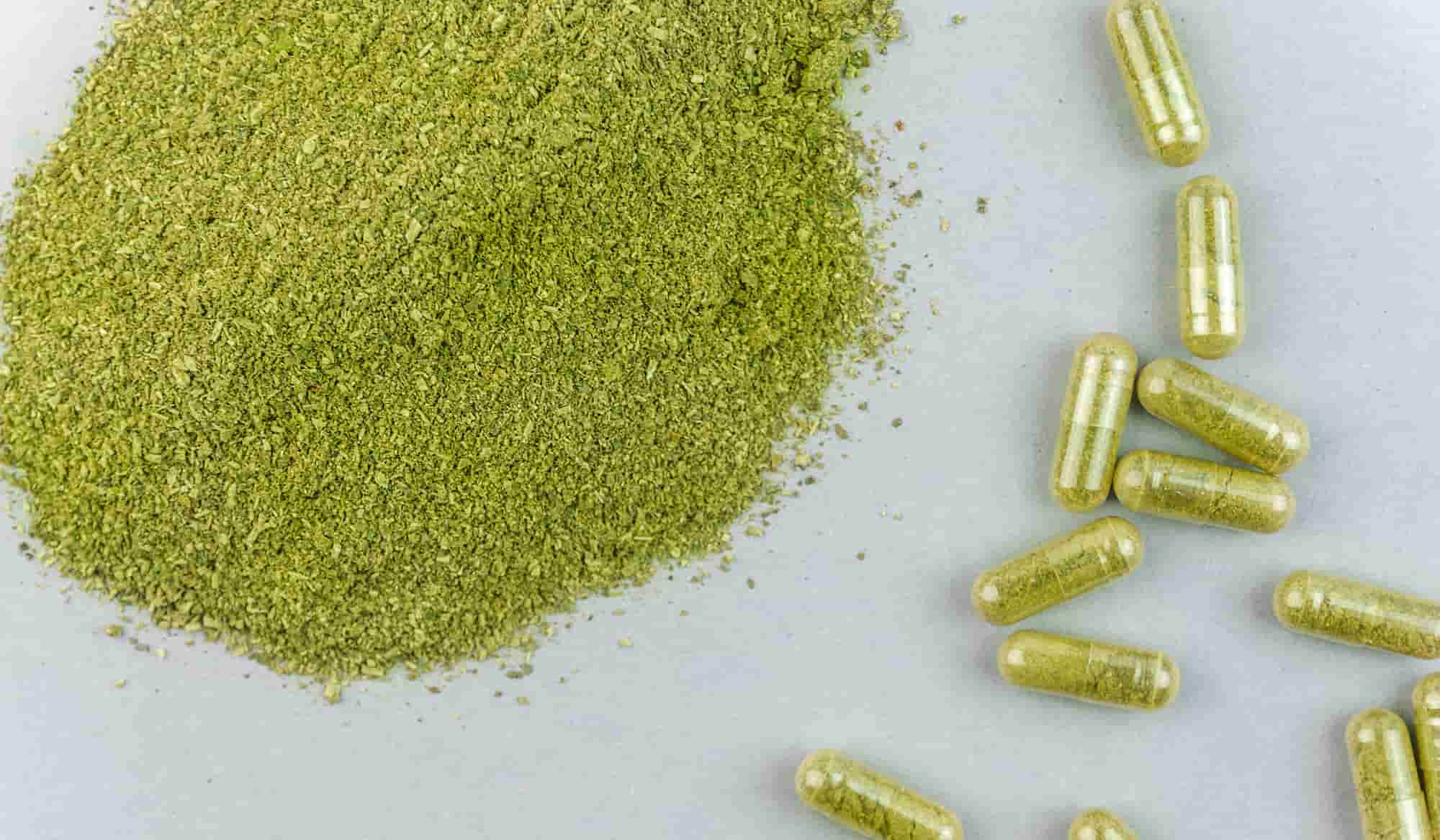
Raw leaf carries 7-OH only in trace amounts. Extraction, heat, and chemical processing can concentrate it or convert mitragynine into it, which is how an “enhanced” extract or a pressed tablet ends up many times more potent than the leaf it came from. According to HHS’s review cited in the DEA filing, preclinical data indicates 7-OH has abuse potential similar to Schedule I and II opioids.
Higher receptor activity at a smaller dose is the whole safety problem. It means sedation, slowed breathing, tolerance, and physical dependence can arrive faster than someone expects from something sold beside the register.
Which products carry the most risk
Risk tracks with processing. In rough order:
- Isolates, concentrates, and tablets labeled 7-OH or 7-hydroxy. Highest potency and the direct target of the federal action.
- High-multiplier extracts, the ones marketed as 10x or 20x.
- Gummies and other edibles, where a single piece can hold far more than a leaf dose and the candy format invites overconsumption. DEA’s filing specifically notes the appeal of “candy-like” formulations.
- Powdered leaf and tea, typically trace 7-OH and not the federal target.
Products with no manufacturer, no ingredient list, and no batch information are unknowns rather than a lower tier.
Overdose signs and what to do in the moment
Because 7-OH acts on opioid receptors, an overdose looks like an opioid overdose. Slowed or stopped breathing is the sign that matters most.
Also watch for someone who cannot be woken, very small pupils, choking or gurgling sounds, blue or grey lips and fingertips, or a limp body.
If you see these:
- Call 911. Say you suspect an opioid overdose.
- Give naloxone if it is available, following the package directions. CDC guidance on naloxone notes that having it available can save a life where opioid overdose is possible. It may reverse 7-OH-related respiratory depression, and more than one dose is sometimes needed.
- Support their breathing with rescue breaths if they are not breathing.
- Stay until help arrives. Bring the packaging if you have it, so clinicians know what they are treating.
Poison Help is available at 1-800-222-1222.
What 7-OH withdrawal feels like
Stopping abruptly after regular use tends to produce opioid-type withdrawal: nausea, sweating, muscle and joint aches, diarrhea, yawning, restless sleep, anxiety, and strong cravings. SAMHSA’s treatment protocol for opioid use disorder puts early withdrawal from short-acting opioids at 8 to 24 hours after the last dose, fully developed withdrawal at 1 to 3 days, and total duration at 7 to 10 days. Sleep and mood take longer to settle than the physical symptoms do.
Kratom withdrawal overlaps heavily, though people often describe fatigue and low mood as the dominant features. Our 7-OH withdrawal timeline breaks the stages down in more detail, and the kratom detox program page covers what stabilization looks like when kratom is the primary substance.
One thing worth naming plainly: 7-OH withdrawal is less predictable than withdrawal from a prescribed opioid, because product potency varies so much between batches and brands. Two people using what looks like the same amount can have very different weeks.
Treatment for 7-OH and kratom dependence
Care follows opioid-dependence practice: a medical assessment first, then medically supervised withdrawal management, then therapy for whatever is underneath the use.
The honest limitation is that kratom and 7-OH tapering has a thinner evidence base than buprenorphine or methadone protocols for classical opioids. There is no standard published taper for 7-OH. In practice that means treatment leans on close monitoring and symptom management, individualized rather than protocol-driven, with medication decisions made case by case by a physician.
At Ojai Recovery, that starts with an assessment covering vitals, labs, and screening for other substances, because DEA’s toxicology program found 7-OH alongside other drug classes in overdose cases, including opioids such as fentanyl, benzodiazepines, and ketamine. Detox here includes round-the-clock medical monitoring, and people step into residential care, our partial hospitalization program in Ventura, or outpatient treatment depending on what the assessment shows. Where depression, anxiety, or trauma is driving the use, that gets treated at the same time rather than afterward.
Getting help at Ojai Recovery
We are a licensed residential and medical detox program at 158 Rockaway Rd in Oak View, serving Ventura County, Santa Barbara County, and the western edge of Los Angeles County. Same-day admission is often possible, and calls are confidential.
Three ways to start:
- Call (805) 273-8798. An admissions coordinator will ask about your use, your last dose, and your medical history so we can judge withdrawal risk. Answer honestly. The screening decides how safely we can support you, and nothing about it is punitive.
- Verify your insurance. We are in-network with Medi-Cal and with select private carriers, and we accept private insurance and self-pay. Network status and benefit levels vary by plan, so the benefits check is free and confidential and tells you where you actually stand.
- Bring what helps the assessment: photo ID, insurance card, a current medication list with doses, and an emergency contact.
If breathing is affected right now, that is a 911 call, not an admissions call.
Frequently asked questions
Will 7-OH show up on a drug test?
Usually not. Standard workplace panels screen for opioids, benzodiazepines, cocaine, amphetamines, and THC, and they do not reliably detect kratom alkaloids. Specialized laboratory testing can identify mitragynine and 7-hydroxymitragynine, but a lab has to be asked for it specifically.
Does the federal action ban all kratom?
No. It is written around a concentration threshold of 0.050 percent 7-OH, and FDA has said it is not intended to reach natural leaf carrying only trace levels. Whole leaf and plain powdered leaf are not the target. State law is separate, and California’s prohibition is broader than the federal proposal.
When will the federal order take effect?
DEA may issue it any time. The notice of intent stated the order would not be issued before August 5, 2026, and DEA has not published it as of September 3, 2026. Once published, it takes effect immediately and runs two years, with a possible one-year extension.
Can I still legally possess 7-OH I already bought in California?
California’s prohibition targets sale and manufacture rather than personal possession, and 7-OH is not yet federally scheduled. Bear in mind this is a moving area of law, and none of it is legal advice. Ask a licensed attorney about your circumstances.
Does naloxone work on a 7-OH overdose?
It may. 7-OH acts on the same receptor naloxone blocks, so it can reverse the respiratory depression. Responses vary and repeat doses are sometimes needed, so call 911 regardless of whether the first dose seems to work.
How long does 7-OH withdrawal last?
Using SAMHSA’s timeline for short-acting opioids as the reference point, early symptoms appear 8 to 24 hours after the last dose, withdrawal is fully developed at 1 to 3 days, and the acute phase runs 7 to 10 days. Sleep disruption, low mood, and cravings often persist longer. Product potency varies enough between batches that individual timelines differ considerably.
Can I detox from 7-OH at home?
We do not recommend it if you have been using daily, using high-potency products, mixing with alcohol or benzodiazepines, pregnant, or managing another medical or psychiatric condition. Medically supervised withdrawal is safer and considerably more comfortable, and it removes the moment where quitting fails because the symptoms became unbearable alone.
Is 7-OH risky during pregnancy or breastfeeding?
Data specific to 7-OH in pregnancy is limited, and CDPH’s warning lists fatal respiratory depression among the risks of these products generally. Because 7-OH acts on opioid receptors, the concerns that apply to opioid use in pregnancy are the reasonable starting point. If you are pregnant or breastfeeding, do not stop abruptly on your own. Talk to a clinician who can coordinate care for you and the baby. [Claim needs verification by Carmen/Ojai: neonatal withdrawal specific to 7-OH is not established in the sources reviewed here, so this answer deliberately stops short of asserting it.]
How do I know whether a product contains 7-OH?
Often you cannot tell from the label. Products naming “7-OH,” “7-hydroxy,” or an extract multiplier are the clearest signals, but unlabeled concentrates and edibles are common and testing is not something a consumer can do at home. If you are unsure what you have been taking, tell the clinical team what you know and they will work from your symptoms.
Does insurance cover treatment for 7-OH dependence?
Often, though it depends on your plan and level of care. We are in-network with Medi-Cal and select private carriers, and network status and benefit levels vary by plan. A free benefits check confirms your coverage before you commit to anything.
Medically reviewed by Gina Rossetti, MD, Medical Director, Ojai Recovery. Published September 3, 2026. Last updated September 3, 2026.
This article is for informational purposes only and is not a substitute for professional medical advice, diagnosis, or treatment, and nothing in it is legal advice. Always consult a qualified healthcare provider about your situation. If you are in crisis, call or text 988 for the Suicide and Crisis Lifeline. For a suspected poisoning or overdose, call 911 or Poison Help at 1-800-222-1222.